Nasal washing covers a range of techniques, materials and procedures that must be adapted to the child's age and to the carers available to carry it out, since safety is a priority that should never be overlooked in any nasal wash!
Nasal Washing in Babies
The aim of the technique is to wash the nasal passages and the posterior nasopharynx, through a flushing effect, by instilling saline solution (an isotonic solution) into each of the child's nostrils.
As for the nasal washing kit, you can put together your own by buying the syringe, adapter and saline solution at any pharmacy.
If it is easier, there are several standard kits available to buy.
Points to watch
Pressure is our enemy — make sure you count to 2–3 seconds with each instillation! Too much pressure will push saline and bacteria towards the Eustachian tube in your little one's ear!
From what age can nasal washing be done?
From birth through to adulthood! Always adjusting the materials and the volume of saline to what is most appropriate.
Should I do a nasal wash every day? No! Only when you see signs of nasal congestion (the presence of mucus).
Ready for those washes? Let's go!
Babies from 0+ to 4 months:
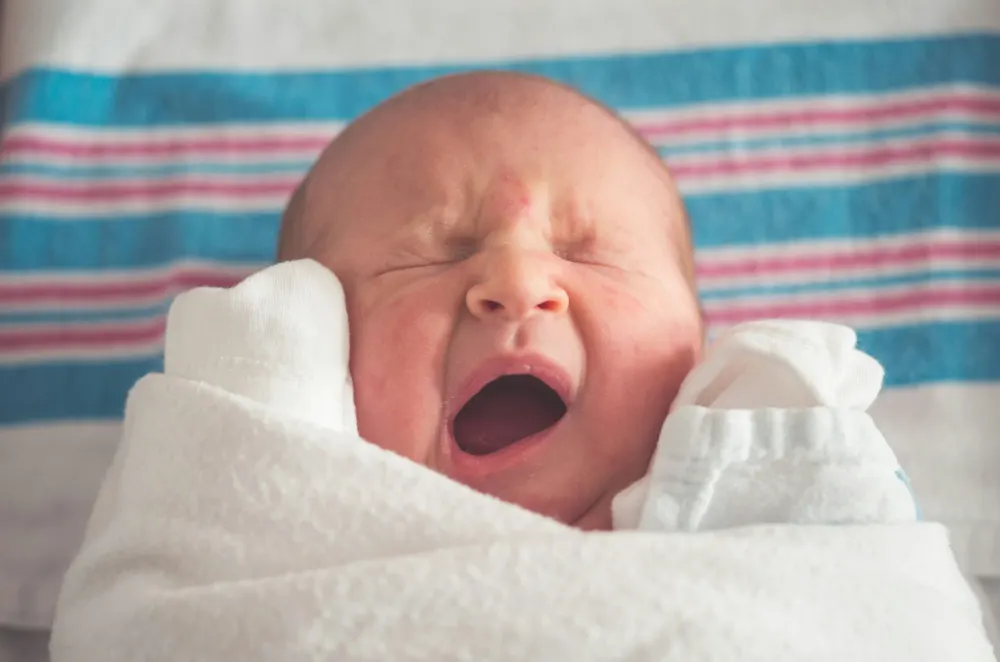
Position the child on their side and use a syringe with a paediatric nasal adapter with 5ml. Slowly instil the saline into the uppermost nostril, and wipe away the mucus that comes out of the other nostril and/or the mouth. Repeat, lying the child on the other side, instilling the saline into the upper nostril (repeating the process).
Babies from 5 to 11 months
In this age group, we move the child to a sitting position on the mother's or father's lap, and use a towel or cover in front of the child to catch the saline. We continue to use a syringe with a paediatric nasal adapter, but with 10ml in each nostril.
In this procedure the challenge is keeping the child still against your lap while instilling the saline. If it helps, ask another carer to hold the child while you carry out the technique, always maintaining maximum safety.
Children aged 1 to 2 Years
From 12 to 24 months, the washing technique depends a great deal on the child's cooperation. If they are not used to it, or the child will not allow it, doing it sitting on an adult's lap proves more effective. If they are more independent with the technique, opt for doing it during bath time!
You should continue using a syringe with a paediatric nasal adapter, with volumes in the region of 15–20ml in each nostril!
Children aged 2 to 3 Years
Ideally at bath time, or standing in front of the sink, the child can now manage instillations of around 50ml in each nostril, with larger syringes, still using a paediatric nasal adapter.
Children aged 3+
After the age of 3, children develop their independence and cooperation with the nasal washing technique. From this age, washing with high-flow volumes is acceptable. A washing system (nasal douche) is preferable, and 75ml is more than enough to wash each of the nasal cavities well.
Still have questions?
Come and clear them up, and learn a little more about respiratory hygiene, at the integrative paediatric physiotherapy appointment!